


How to Shop Sales Without Losing Your Plan
50% OFF. LIMITED TIME ONLY. BUY ONE, GET ONE FREE.
As the year comes to an end, these messages seem to be everywhere.
From Black Friday and Cyber Monday promotions to Christmas specials and year-end clearance sales, shoppers are surrounded by offers promising more value for less money.
And with the rising cost of living, finding ways to stretch your money is becoming increasingly important. When groceries, transportation, utilities and other everyday expenses are taking up more of your income, a good sale can feel like an opportunity you shouldn’t miss.
But here’s something worth considering: Just because something is on sale doesn’t automatically mean you’re saving money.
Sometimes, a discount helps you spend less on something you already needed. Other times, it encourages you to spend money you hadn’t planned to spend in the first place.
Understanding the difference can help you make better purchasing decisions without missing out on genuine opportunities to save.
Why Sales Are So Hard to Ignore
Retailers don’t simply reduce prices and hope customers notice. Promotions are carefully designed to attract attention, encourage interest and make purchasing feel worthwhile.
There’s nothing inherently wrong with marketing. Businesses need to sell products, and consumers can benefit from competitive pricing.
However, understanding some common sales techniques can help you recognise when a promotion is influencing your decision.
 1. Urgency: “Sale Ends Tonight!”
 1. Urgency: “Sale Ends Tonight!”
Countdown timers, flash sales and limited-time promotions create a sense that you need to act immediately.
When an offer appears to be disappearing, you may focus more on the possibility of missing it than on whether you actually need the item.
Before rushing to checkout, ask yourself:
Would I still want this if the sale ended yesterday?
If the answer is no, the deadline may be influencing your decision more than the product itself.
2. Discounts: “Was $800, Now $400!”
A 50% discount sounds impressive, especially when the original price is displayed prominently.
But the size of the discount doesn’t tell you whether the item is worth buying.
Consider two situations:
- You planned to purchase a household appliance for $800, researched your options and found the same model on sale for $600.
- You weren’t planning to purchase a new appliance, but a 50% discount convinced you to spend $400.
In the first situation, the promotion helped reduce a planned expense by $200.
In the second, you spent $400 you hadn’t intended to spend.
Neither decision is automatically wrong, but the financial outcomes are different.
The real saving isn’t always the amount shown on the discount tag. It’s what you avoid spending unnecessarily.
3. Scarcity: “Only 2 Left!”
Messages such as “Almost Sold Out” or “Limited Stock Available” can make products feel more desirable.
When availability appears restricted, we may place greater value on getting the item before someone else does.
Scarcity can be genuine, particularly for popular products. But it shouldn’t replace consideration of your budget, needs and alternatives.
4. Bundles: “Buy More and Save More!”
Bundles can provide good value when you genuinely need everything included.
For example, purchasing household essentials in bulk at a lower unit price may help reduce costs over time. However, buying three items when you only need one doesn’t necessarily represent a saving, even if the price per item is lower.
The question is whether you’ll actually use what you’re buying.
5. Easy Checkout: When Spending Takes Seconds
Online shopping has made purchasing more convenient than ever.
Saved payment details, one-click checkout, shopping apps and personalised recommendations reduce the time and effort required to complete a purchase.
That convenience is useful, but it also removes some of the natural pauses that might otherwise give you time to reconsider.
An item can move from your social media feed to your shopping cart and then to your doorstep with very little thought in between.
Sometimes, creating a little distance between wanting something and buying it is all you need to make a more deliberate decision.
A Good Deal or an Unplanned Expense?
Before making a purchase, try using this simple five-question check.
1. Did I need or want this before I saw the sale?
If the item was already on your shopping list, the promotion may be helping you achieve something you’d planned.If the desire only appeared after seeing the advertisement, consider whether it’s worth adjusting your budget.
2. Can I afford the final cost?
Look beyond the advertised price. Include delivery fees, taxes, foreign exchange charges and other applicable costs, particularly when shopping internationally.
A $300 item may cost considerably more by the time it reaches Trinidad and Tobago.
3. Have I compared the price?
Check whether the item is genuinely cheaper than usual. Compare prices across retailers and, where possible, review previous prices.
A large percentage discount doesn’t always mean you’re getting the lowest available price.
4. Will I use it enough to justify the purchase?
Consider the product’s usefulness, quality and how frequently you’ll use it.
An inexpensive item that sits unused can offer less value than a more expensive item that meets an important need for years.
5. What will I have to give up or delay to buy it?
Every purchase uses money that could have gone somewhere else.
If buying the item means postponing a bill, reducing essential savings or relying on debt you cannot comfortably repay, the discount may not be worth the financial pressure.
QUICK CHECK
50% OFF doesn’t answer the most important question.
Was it worth buying in the first place?
Shop the Sales Without Losing Your Budget
The answer isn’t necessarily to avoid sales. It’s to approach them with a plan.
And that plan doesn’t need to be complicated.
Whether you’re paid weekly, fortnightly, monthly, earn commissions or receive income irregularly, the principle remains the same: know what your money needs to cover before deciding how much is available for shopping.
BEFORE YOU CHECK OUT
Would I buy this item at its regular price?
Start With What You Can Actually Spend
Before browsing promotions, identify the money already committed to essentials such as bills, groceries, transportation, loan payments and other obligations. Then consider any expenses approaching in the coming weeks.
Remember, November and December spending doesn’t happen in isolation. January still comes with bills, school expenses and other financial commitments.
Whatever remains after accounting for your priorities can help you determine a realistic shopping limit.
If there’s little or nothing available, that may mean adjusting your shopping plans rather than forcing purchases into an already stretched budget.
Set a Spending Limit Before You Shop
Decide how much you can comfortably spend on gifts, clothing, household items and other purchases.
For example, if you’ve allocated $1,200 for year-end shopping, that amount becomes your overall limit – not the starting point for additional spending. You can divide it into smaller categories based on your priorities.
A budget doesn’t have to remove enjoyment from the season. It simply helps you enjoy it without creating unnecessary financial pressure afterwards.
Use a Savings Method That Matches Your Income
Saving doesn’t always require putting aside a large amount at once.
The approach you choose should reflect how and when you receive money.
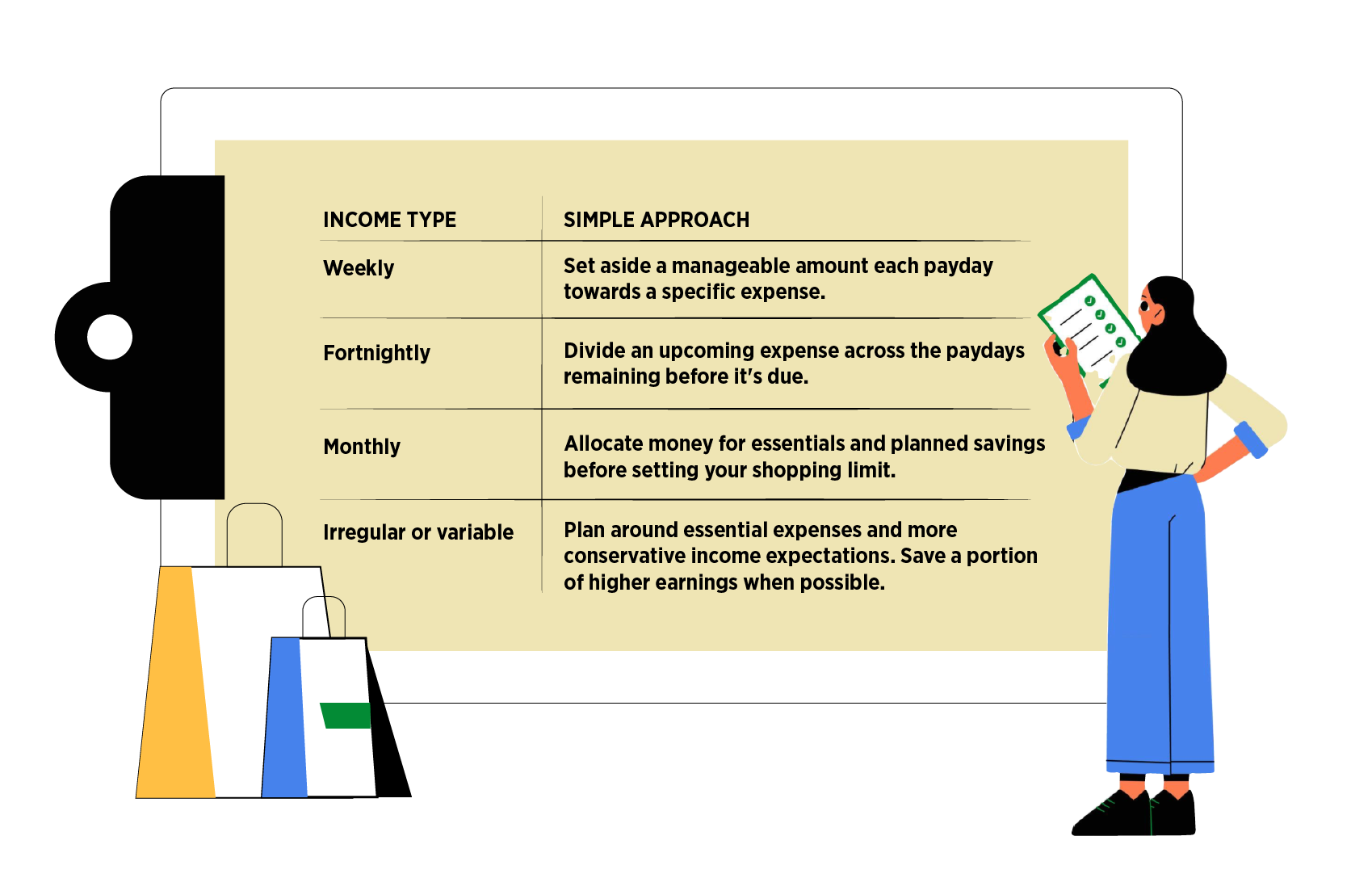
For example, if you’re planning a $600 purchase in six weeks and you’re paid weekly, setting aside $100 per week could help you pay for it without relying on your next full salary.
If you can’t save the entire amount, even preparing part of the cost can reduce the financial pressure.
The goal is consistency and affordability, not forcing yourself to save an amount that leaves you struggling with necessities.
Create a Shopping List and Rank Your Priorities
Separate your planned purchases into three categories:
- Must Buy: Items you genuinely need or have already committed to purchasing.
- Would Like: Items you want but can postpone if necessary.
- Only If Affordable: Additional purchases that fit comfortably within your remaining budget.
This approach gives you some flexibility without allowing every attractive offer to become a priority.
Try the 24-Hour Rule
For non-essential purchases, consider leaving the item in your cart for at least 24 hours. During that time, check your budget, compare alternatives and decide whether you still want it.
You may find that the excitement fades once the countdown timer or promotional message is no longer in front of you.
And if the item sells out? There will likely be other promotions and opportunities.
Not every missed sale is a missed opportunity.
Shop Online, But Shop Safely
Holiday shopping isn’t only about protecting your budget. It’s also about protecting your personal and financial information.
As online promotions increase, shoppers may encounter fake stores, misleading advertisements, phishing messages and fraudulent payment requests.
A few precautions can help reduce your exposure.
- Check the retailer before purchasing. Use official websites or verified store accounts. Be cautious with unfamiliar sellers, particularly when prices seem unusually low.
- Avoid clicking unfamiliar promotional links. Fake advertisements, emails and messages can imitate legitimate retailers. When in doubt, navigate directly to the retailer’s official website.
- Use secure payment methods. Choose payment options with appropriate protections, and avoid sharing banking credentials, PINs or one-time passwords.
- Review the final amount. Confirm the currency, delivery charges, shipping arrangements, taxes and other fees before completing your purchase.
- Read the return and refund policy. A discounted item may have restrictions that affect whether you can exchange or return it.
- Monitor your transactions. Review your account activity and enable transaction alerts where available so you can identify unfamiliar charges promptly.
A secure-looking website or an attractive advertisement isn’t proof that a seller is legitimate. Taking a few extra minutes to verify a purchase can help prevent a much more expensive mistake.
ONLINE SHOPPING SAFETY CHECK
Before entering payment details, verify the seller, total cost, return policy and payment method.
Remember: The Sale Isn’t Your Last Chance to Save
One of the strongest pressures surrounding holiday promotions is the idea that you must take advantage of every opportunity before it disappears.
But sales happen throughout the year.
And while some promotions genuinely offer exceptional value, there will always be another product, another advertisement and another reason to spend.
With the rising cost of living, being selective about purchases is becoming increasingly important.
That doesn’t mean you shouldn’t enjoy the season, buy gifts or take advantage of discounts. It means recognising that your financial priorities should guide your purchases, rather than allowing promotions to determine your priorities.
A good deal is one that offers value, meets a genuine need or want, and fits comfortably within what you can afford.
So, before your next purchase, look beyond the percentage discount. Ask yourself:
Am I buying this because it’s a good deal – or does it only feel like a good deal because of the marketing?
Sometimes, the best financial decision isn’t finding the biggest discount. It’s knowing when to buy, when to wait and when to walk away.