
Staff Writer | September 18, 2026
The Difference Between Spending Money and Using Money

Most people learn how to spend money long before they learn how to use it.
From a young age, money is often framed around paying bills, buying necessities, covering expenses and getting through the month. We learn that money comes in, things need to be paid for, and money goes back out.
And while all of those things are real and necessary, we aren’t always taught to think about what else our money can do.
Money can help create stability. It can prepare us for expenses that haven’t happened yet. It can provide protection when something unexpected happens. It can give us more choices and help create opportunities for the future.
That’s where the difference between simply spending money and using money intentionally begins.
Spending Money Isn’t the Problem
Spending is a normal part of life.We exchange money for products, services, experiences, convenience and things we enjoy. Paying your electricity bill is spending. Buying groceries is spending. Going out with friends is spending. So is taking a vacation you’ve been looking forward to.
The goal isn’t to stop spending or to make every dollar serve some distant financial objective.
Instead, it’s about recognising that your money can have different jobs – and deciding what those jobs should be before everything gets absorbed by what’s happening right now.
Consider $500.
That TT$500 could pay for groceries. It could go towards a night out. It could be added to an emergency fund, put towards an upcoming expense or used to make an additional payment on a loan.
None of those decisions is automatically right or wrong.
The important question is: What does this money need to do for me right now
That’s intentional money management.
QUICK CHECK: Having it doesn’t always mean you can afford it.
Before spending, ask yourself: What else does this money need to do before I get paid again?
Why We Get Stuck in Spending Mode
For many households, long-term financial planning can be difficult when there are immediate financial pressures.
The cycle can become familiar:
You get paid. The bills are due. Groceries need to be bought. Transportation has to be covered. Something unexpected comes up. Whatever remains handles everything else until the next payday.
When money feels tight, the focus naturally becomes what’s due now, what’s urgent and what can wait.
Sometimes, there genuinely isn’t enough money available to make every financial decision you would like to make. That’s an important reality to acknowledge. Intentional money management doesn’t magically create income that isn’t there.
But when this cycle continues month after month, it can also become difficult to distinguish between money that has to be spent now and money that could be directed towards something else.
This is one reason savings, insurance and planning for future expenses can sometimes feel like additional expenses rather than financial tools. Their benefits aren’t always immediately visible.
But putting money aside for an emergency today could mean relying less on debt when something goes wrong later. Preparing gradually for an annual expense could mean one month’s salary doesn’t have to carry the entire cost. Having appropriate financial protection could reduce the impact of an unexpected event.
Using money intentionally means considering both today and what comes after today.
Give Your Money a Job
One way to start thinking differently about money is to give it a job before you spend it.
That doesn’t require an elaborate spreadsheet or dozens of budget categories. You can start by thinking about five simple areas:
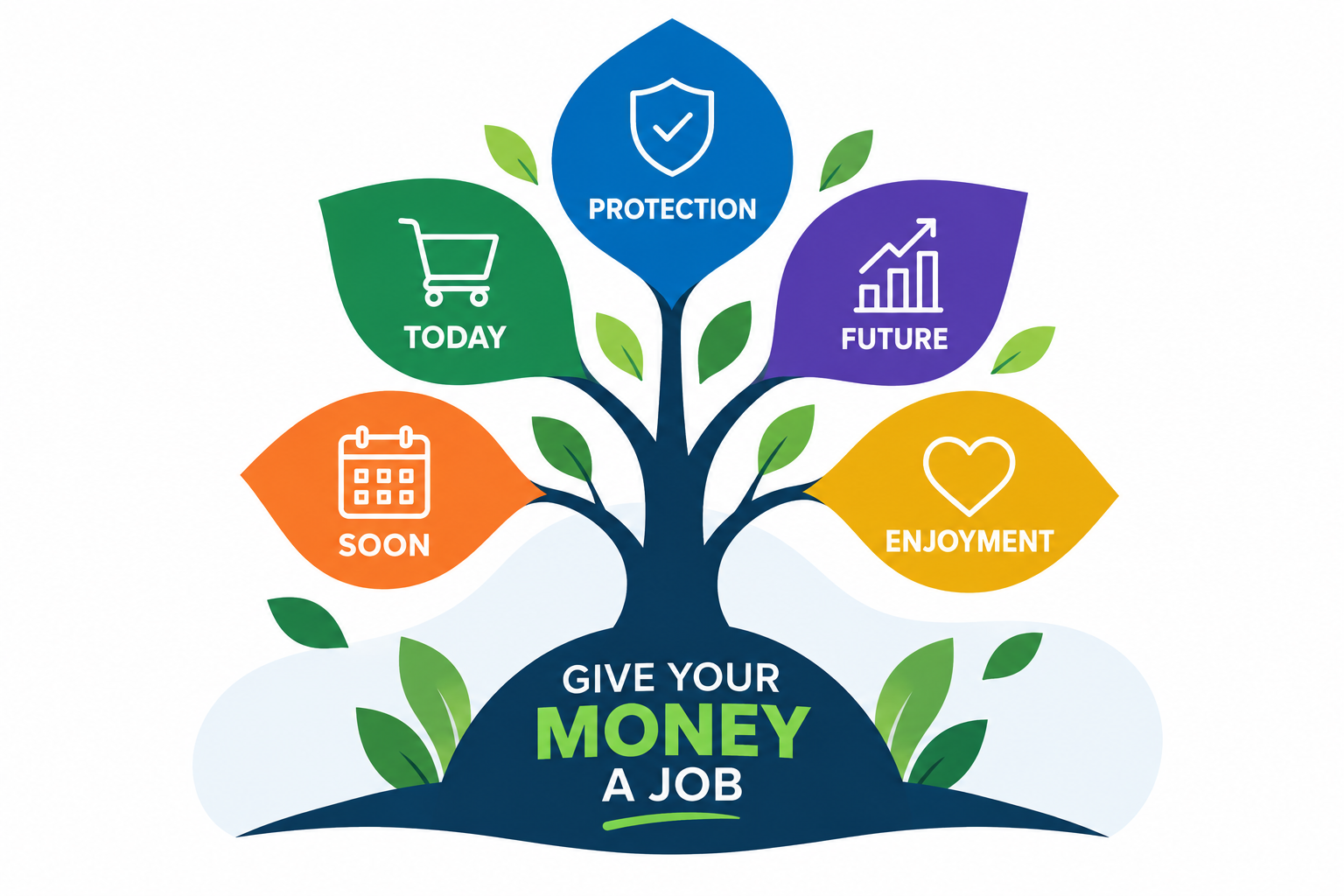
TODAY
What needs to be covered now? Think bills, groceries, transportation and other immediate expenses.
SOON
What do you know is coming? This might include school expenses, vehicle maintenance, annual fees, Christmas, travel or another planned expense.
PROTECTION
What can help cushion you financially if something unexpected happens? Emergency savings and appropriate insurance are examples.
FUTURE
What are you building towards? This could include reducing debt, saving towards a home, education, retirement or another long-term goal.
ENJOYMENT
What do you want your money to allow you to experience now? Entertainment, hobbies, eating out and other wants can have a place in your financial plan too.
The aim isn’t necessarily to put money into every category every time you’re paid. Your priorities will change, and some periods will demand more from one area than another.
The important part is making more of those decisions deliberately.
TRY THIS: Give your next TT$100 a job before you spend it.
It could go towards today, an upcoming expense, protection, your future – or something you simply want to enjoy. The goal isn’t restriction. It’s intention.
Same Money. Different Jobs.
Imagine that after your immediate obligations are covered, you have $600 remaining.
Without a plan, that $600 might gradually disappear over the next two weeks through several small purchases. You may not necessarily regret any individual purchase, but by the end of the period, you might wonder where the money went.
Now imagine deciding in advance that the same $600 will do several things:
- $200 for entertainment and other personal spending
- $150 towards an expense you know is coming
- $150 towards emergency savings
- $100 as an additional payment towards debtIt’s still $600.
The difference is that the money was given a purpose before other things competed for it.
And your allocation doesn’t have to look like this example. Someone else’s priorities may be completely different from yours.Intentional money management isn’t about following one perfect formula. It’s about knowing why your money is going where it’s going
Start Asking Better Financial Questions
One of the most useful changes you can make isn’t necessarily changing what you buy. It may simply be changing the questions you ask before you spend.
Instead of only asking:
“Can I afford this?”
Try asking:
“What else does this money need to cover?”
“Is there an expense coming that I haven’t prepared for yet?”
“Will this decision reduce or increase financial pressure later?”
“Am I choosing this deliberately, or am I spending because the money is available?”
“Does this fit with what I’m trying to accomplish financially?”
Having $1,000 in your account, for example, doesn’t necessarily mean you have $1,000 available to spend.
Part of that balance may already have a future job – it just hasn’t left your account yet.That distinction between your account balance and your available-to-spend balance can make a significant difference in how you manage your money between paydays.
Prepare for the Expenses You Can See Coming
Not every financial surprise is actually a surprise.
There are expenses that happen irregularly but predictably: birthdays, school expenses, insurance renewals, vehicle maintenance, Christmas, annual subscriptions and other recurring costs.
Because they don’t happen every month, it’s easy to treat them as a problem for the month in which they arrive.Instead, consider preparing gradually.
If you know you’ll need $1,200 for an expense six months from now, for example, you could think about it as $200 per month rather than a $1,200 problem waiting for you six months from now.
The expense hasn’t changed. What has changed is how much pressure it may place on you when the time comes.
THINK AHEAD: What’s one expense you already know is coming?
Estimate the cost, look at how much time you have before it’s due and work backwards. Even if you can’t save the full amount, preparing part of it can reduce the amount your future income has to carry.
Build a More Intentional Relationship With Money
Using money intentionally doesn’t mean removing enjoyment from your life.
And it doesn’t mean every financial decision has to be perfect.
It’s about creating a better balance between what you need and want today and what you’re trying to protect or build for tomorrow.
That can start with relatively small actions:
- Move a manageable amount into savings when you’re paid instead of waiting to see what’s left.
- Prepare monthly for expenses that only happen once or twice a year.
- Review recurring subscriptions and expenses periodically.
- Set boundaries around spending you know tends to happen impulsively.
- Make additional debt payments when your circumstances allow.
- Check your financial goals periodically and adjust them as your life changes.
You don’t have to do all of these at once.
One intentional decision repeated consistently can be more useful than an ambitious financial plan you can’t realistically maintain.
So, What Is Your Money Doing for You?
Financial stability isn’t built through income alone.
How money is managed, directed and protected matters too.
That doesn’t mean there will always be enough money to do everything at once. There will be months when immediate needs take priority, unexpected expenses disrupt the plan or a financial goal needs to be adjusted.
Intentional money management allows for that reality.
The goal isn’t to feel guilty every time you spend. It’s to become more aware of the choices available to you and, when possible, make decisions that support both your present life and your future one.
So the next time money comes in, try asking a slightly different question.
Not only:
“What do I need to spend this on?”
But also:
“What do I need this money to do for me?”